14 July: a spotlight on the pyrotechnicians of the Fête nationale
As the Fête nationale approaches, French pyrotechnicians enter the most intense period of their year, where technical precision, artistic creation and public safety come together. From the grand Paris show to the fireworks launched in towns across the country, 14 July is a reminder that pyrotechnics remains a popular, demanding and profoundly unifying art.
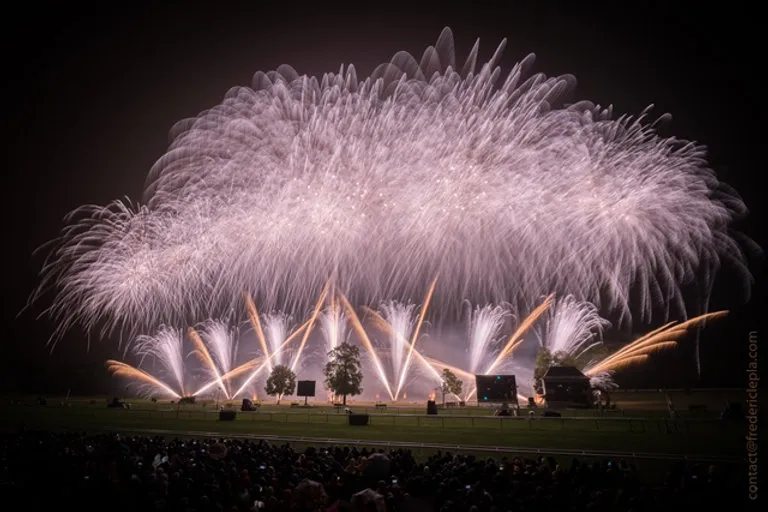
In a few days, the sky over France will once again feel that particular anticipation that comes before great summer evenings. Along the riverbanks, in the squares, on the racecourses, in the parks and on the esplanades, spectators will look up to a night they hope will be clear, ready to share the same thrill. 14 July is not just a date on the republican calendar: it is also one of the great popular gatherings of pyrotechnics. In Paris, Compiègne, Bordeaux, Cannes, in seaside resorts and in villages alike, fireworks tell the same story each year: that of a spectacular, precise, collective art, where light becomes language.
14 July, a major event for fireworks professionals
For the general public, a fireworks display begins with the first cannon blast and ends with the final bouquet. For fireworks professionals, it begins much earlier. Bastille Day is one of the highlights of their season, often prepared several weeks, sometimes several months, in advance. The scenario must be designed, the effects chosen, the rhythm established, the pyrotechnic score adapted to the site, safety constraints anticipated, teams coordinated and the weather monitored until the very last moment. Behind the apparent magic of a sky opening in red, gold, blue or silver corollas lies meticulous organization.
14 July concentrates all the demands of the profession. Displays must be readable by a very broad audience, often families, sometimes seated far from the firing site. They must captivate within minutes, surprise without losing coherence, and respect distances, timings and prefectural or municipal instructions. The fireworks professional is therefore not only a technician of fire: they are also a director of space, time and emotion. Their work is to transform an institutional celebration into a sensory experience, capable of bringing thousands of gazes together around the same horizon.
A republican tradition turned popular spectacle
France’s national holiday refers to two founding moments: the storming of the Bastille on 14 July 1789, and the Fête de la Fédération, celebrated on 14 July 1790 as a symbol of unity. Since the end of the 19th century, this date has established itself in the collective imagination as a day of parades, dances, concerts, ceremonies and fireworks. In the evening, solemnity gives way to a more sensory ritual: the anticipation in the crowd, the first bursts, the silence before the explosion, then the applause that follows the great tableaux.
This popular appeal lies in the very nature of fireworks. They require no entry code, no prior knowledge. They speak to children and adults alike, to connoisseurs and the merely curious. Each person may see technical prowess, a moving painting, a childhood memory or a shared festive moment. This explains their unique place in 14 July celebrations: fireworks are at once event, backdrop, signal and collective emotion.
Composing a display: colour, rhythm and breath
A successful pyrotechnic show is not simply an accumulation of effects. It is composed like a work in several movements. The opening sequences set the atmosphere, establish the tone, and trace the height and width of the sky. The intermediate tableaux vary the textures: ascending comets, golden palms, weeping willows, crackles, peonies, chrysanthemums, crowns, cascades, nautical effects when the site allows. The finale, in turn, must deliver the expected surge without overwhelming what has come before. Too early, it tires the eye; too late, it lets the tension fall. The art lies in this sense of breath.
Colour plays an essential role. Red, white and blue naturally impose themselves in the symbolic world of Bastille Day, but fireworks professionals do not stop there. Deep golds lend majesty, greens bring a vegetal freshness, violets and electric blues create more contemporary atmospheres. The challenge is to balance these nuances with the music, duration, firing density and visual reading from the audience. The same effect can seem grand on a vast body of water and too compact in an urban setting. The venue dictates part of the writing.
From the ground to the console, precision before wonder
Before the sky ignites, the work is first and foremost terrestrial. Teams install the mortars, secure the areas, check firing angles, connect lines, inspect products and organize the sequences. Putting on a professional fireworks display requires qualifications, procedures and perfect coordination with local authorities, security services, emergency responders and organizers. The public sees neither the plans, nor the calculations, nor the hours of setup. Yet it is this invisible rigour that makes wonder possible.
Weather adds its share of uncertainty. Excessive wind, an unfavourable direction, significant dryness or a risk of storms can alter, delay or compromise a firing. Fireworks professionals therefore work with the humility of those who know the sky can never be fully controlled. This is also what makes each show unique. Even when programmed to the millimetre, a fireworks display remains a living art, subject to air, light, topography, distance and the perception of those watching.
Compiègne, Paris, Cannes: very different stages
Large cities often provide spectacular settings. In Paris, the perspective of the Eiffel Tower gives the 14 July fireworks iconic reach, followed far beyond the Champ-de-Mars. In Cannes, pyrotechnic history is rooted in a tradition of festivals and international competitions on the Mediterranean coast. In Bordeaux, the quays and the water mirror offer a highly distinctive urban stage. In Compiègne, fireworks take on a special resonance thanks to the Masters de Feu, which have established in the city an international event dedicated to the art of pyrotechnics.
Each site imposes its own signature. A display launched over a river plays with reflections. A display staged in a racecourse benefits from ideal depth for great luminous architectures. An urban display must work with buildings, access routes, spectator flows and safety requirements. This diversity is the richness of 14 July: there is not one national-fireworks model, but a multitude of local readings, adapted to the history, landscape and audience of each territory.
When the national holiday meets the spirit of Masters de Feu
At Masters de Feu, the public finds that same fascination, but within an international competition setting. Where 14 July celebrates the nation and popular gathering, the competition highlights the virtuosity of fireworks houses, their creativity and their ability to move audiences within a constrained timeframe. Spectators do not come only to see a display: they compare styles, discern signatures, discover different forms of writing. Silver Master, Gold Master and Platinum Master embody this demand for recognition, where pyrotechnics are judged as an art of precision as much as a spectacle.
This bridge between popular celebration and excellence competition is invaluable. It reminds us that 14 July fireworks are not interchangeable events. They are the product of trades, workshops, inherited know-how, technical innovation and artistic choices. The spectator who discovers a major pyrotechnic competition no longer looks at fireworks in quite the same way: they notice transitions, listen to musical synchronisation, observe the height of the effects, the sharpness of the colours, the balance between intensity and silence.
Looking at 14 July fireworks differently
This year again, when the sky lights up, it will only take a few seconds for the crowd to return to its simplest reflex: to look up. But behind the brilliance of the final bouquet, one can also think of those who prepared this moment in the shadows. The fireworks professionals who write with powder, the teams who install in the July heat, the local authorities who orchestrate the celebration, the services that secure it, the families waiting for the first shot. 14 July is a great evening for the Republic; it is also, every year, one of the finest showcases for pyrotechnic art in France.