At Masters de Feu, the challenge of an ever more responsible show
Fireworks do have a real environmental impact, but it is often underestimated. At Masters de Feu, organizers and pyrotechnicians are working on materials, show design, site cleanup and audience mobility to reduce it.
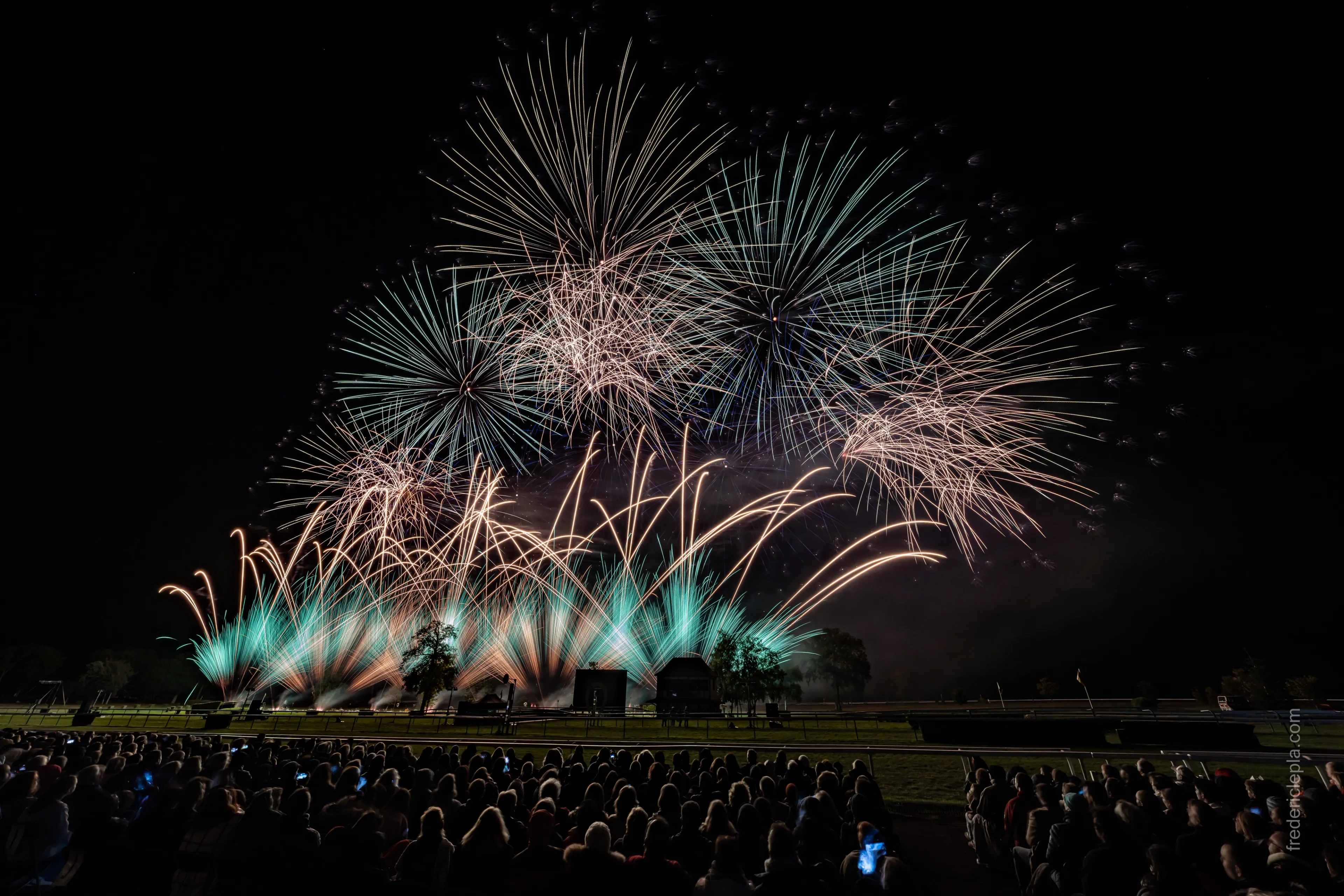
For a few dozen minutes, the sky is set ablaze. Then the lights go out, the audience leaves the site, and another part of the work begins: checking the firing areas, collecting residues, cleaning the occupied spaces, and drawing lessons from the edition just concluded.
For a long time, the success of a fireworks display was measured by the emotion it created, the quality of its soundtrack, or the precision of its timing. These criteria remain essential. But they are no longer enough.
Like all major cultural events, the Masters de Feu must now meet a requirement that has become unavoidable: reducing their environmental impact without giving up their primary vocation, which is to bring people together and inspire wonder.
Recognizing impacts without exaggerating them
A fireworks display is not a neutral activity.
Its creation involves the manufacture and transport of pyrotechnic products, the combustion of active materials, occasional emissions of particles, noise, the movement of staff and spectators, as well as the production of waste.
Acknowledging this does not weaken pyrotechnics. On the contrary, it makes it possible to identify the real levers for improvement.
Yet public debate often suffers from two opposing excesses. The first is to deny any impact at all. The second is to portray every show as an ecological disaster, sometimes relying on outdated figures, exceptional cases, or data stripped of context.
The reality is more complex.
The effects vary depending on the duration of the show, the quantity and nature of the products used, the layout of the site, weather conditions, the time of year, and the number of spectators welcomed.
Measuring the event as a whole
To act effectively, one must first know where the main emissions come from.
A carbon assessment carried out in 2025 by the consultancy Carbometrix on the Fête du Lac d’Annecy provides a concrete perspective. This study, conducted according to the GHG Protocol, covers a 70-minute fireworks display using nearly two tonnes of active material and attended by around 202,000 spectators.
The result is telling: audience travel accounts for 97% of the assessed overall carbon footprint. The fireworks themselves account for about 1%.
This does not mean that pyrotechnics have no impact. It shows that, for an event of this scale, the main source of emissions lies elsewhere: in the journeys required to reach the site.
Reducing the environmental footprint of a major show therefore cannot rely solely on the products fired. It also requires reflection on public transport, carpooling, access routes, parking, and audience information.
More precise show design
Progress also comes through the way fireworks are designed.
Digital firing systems now make it possible to program every launch with great precision. This control improves synchronization, but it also makes it possible to build more refined sequences in which each product has a defined artistic function.
The aim is not simply to fire less. It is to fire better.
A show crafted in detail can gain intensity through rhythm, silences, music, variation in height, and the complementarity of effects, rather than through a constant accumulation of material.
This pursuit of artistic efficiency is one of the most concrete levers of contemporary pyrotechnics: creating more emotion with better-controlled quantities.
Products and practices that are evolving
Manufacturers are also evolving their methods and compositions.
Depending on the products and their uses, research is focusing in particular on reducing certain components, controlling smoke, improving combustion, limiting solid fallout, and using materials that are easier to recover or recycle.
These changes remain gradual. Not all colors and effects can be achieved with the same components, and there is currently no pyrotechnic product entirely free of impact.
The approach, then, is less about promising an immediate revolution than about organizing continuous improvement, product by product and show by show.
A specification imposed on the teams
At the Masters de Feu, this responsibility is reflected from the very preparation of the event.
The participating international teams must comply with the site’s technical, environmental, and safety constraints. The choice of products, their placement, fallout zones, and the organization of firing positions are all subject to precise preliminary work.
The pyrotechnicians are also made aware of the need to respect the spaces they occupy. Temporary installations must be carefully managed, materials recovered, and work areas cleaned after operations.
The event’s spectacular nature does not exempt it from this discipline. On the contrary, it makes it essential.
After the grand finale, the cleanup
The audience sees the fireworks. They see less often what follows.
After the show, teams inspect the firing and fallout areas. Visible residues are collected, equipment dismantled, and waste directed to the available processing streams.
This phase may continue the day after the event. It is essential, especially on natural, agricultural, or sports sites.
Recovering every fragment in full remains difficult to guarantee across a large area, but the objective is clear: to minimize the traces left by the show and return the site in the best possible condition.
Reusing equipment also contributes to this logic. Mortars, structures, cabling, protective elements, firing equipment, and certain packaging can be used on multiple operations, thereby limiting the production of single-use waste.
Wildlife, a subject that calls for nuance
The impact of noise on animals is among the most sensitive issues.
Available scientific studies show that fireworks can trigger escape or flight responses, particularly in certain bird species. The intensity of these reactions, however, depends heavily on the location, the season, proximity to roosting or nesting areas, and the repetition of firings.
These studies must be taken seriously. They do not, however, allow us to conclude that every show systematically causes massive mortality.
The right response is to study the site’s characteristics, avoid the most sensitive areas whenever possible, and integrate biodiversity into event planning. On this issue as on others, scientific knowledge must come before sensational statements.
Drought and fire risk
Recent periods of drought have also brought fire risk back to the forefront.
A professional show is preceded by an analysis of the site and the risks. Vegetation, safety distances, weather conditions, wind, fire-fighting resources, and emergency access are among the parameters studied.
When conditions no longer make it possible to guarantee an adequate level of safety, the authorities may restrict or prohibit firing.
Since the Masters de Feu are held on a fixed date, postponement is not a workable solution. Prevention and anticipation are therefore essential. The safety of the audience, the teams, and the site remains the prerequisite for the show to take place.
Not confusing ecology with renunciation
The environmental transition is sometimes presented as a succession of bans and sacrifices.
Yet this is not the only possible path.
In many sectors, progress has come through innovation, measurement, and improved practices. Pyrotechnics can follow the same path: understanding its impacts more precisely, acting on the most significant sources, evolving products, and designing shows with greater precision.
Audience enjoyment and environmental responsibility are not necessarily incompatible. They do, however, require organizers, pyrotechnicians, manufacturers, local authorities, and spectators to work in the same direction.
An approach meant to continue
The Masters de Feu do not claim to have eliminated the impact of their activity.
The ambition is more realistic: to understand it, measure it, and reduce it gradually.
This means accepting debate, including when it is critical. But it also means ensuring that such debate rests on accurate data, properly interpreted studies, and coherent comparisons.
A major popular show can continue to exist while evolving. That is probably where the real challenge lies: preserving wonder without ignoring the issues of our time.