Hermanos Caballer: Spain answers at Masters de Feu
Final stop in the “Firework artists answer our questions” series: head to Spain, with the Hermanos Caballer team. Ahead of Masters de Feu 2022, Luis Fuentes and José Caballer spoke about team spirit, technical standards and the ambitions of a leading pyrotechnic house from Valencia.
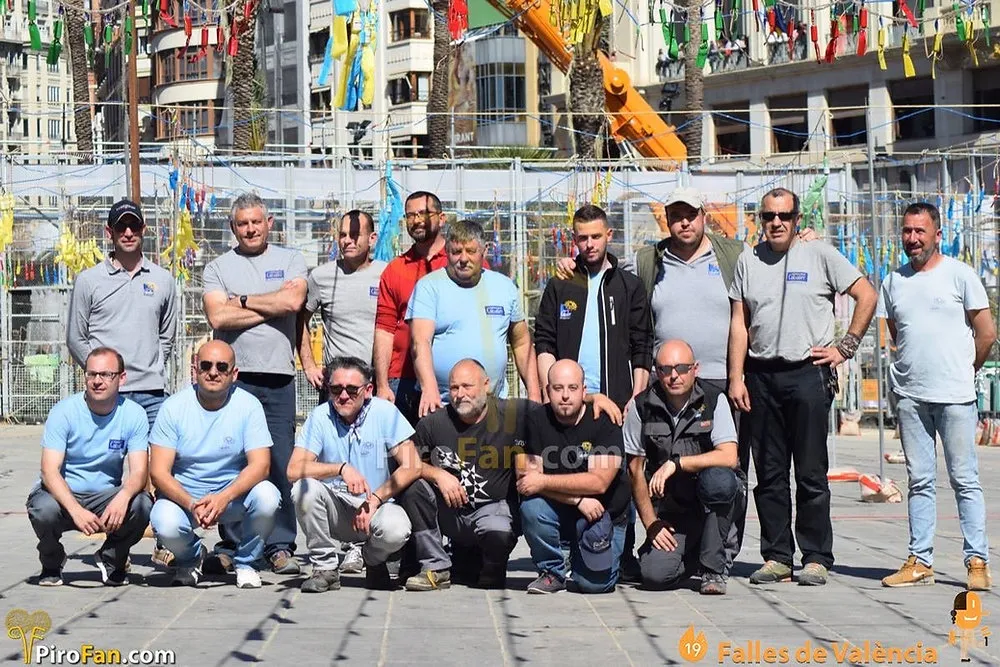
The journey comes to an end where fire is a language all its own: in Spain. To close this series devoted to the pyrotechnicians invited to Masters de Feu, we head to Hermanos Caballer, a pyrotechnic house associated with one of Europe’s strongest traditions of powder, rhythm, and color. Before the fifth edition of the competition, held on 17 September 2022 at the Hippodrome de Compiègne, Luis Fuentes and José Caballer had agreed to answer the questions of Masters de Feu. Their presence gave this edition a highly anticipated tone: that of spectacular, musical, generous Spanish pyrotechnics, but also one held together by constant discipline.
One last Spanish stop on a European pyrotechnic journey
The series “The pyrotechnicians answer our questions” was designed to bring the public closer to those who create the shows. Behind the shells, the light tableaux, the firing sequences, and the perfectly timed moments of silence, there are teams, methods, artistic sensibilities. With Hermanos Caballer, Masters de Feu welcomed a company from a country where pyrotechnics are not only an art of celebration: they are part of a popular, sonic and visual culture, especially in the Valencia region.
This cultural dimension changes a great deal. A Spanish firework display is not limited to a succession of effects in the sky. It often works on momentum, on the relationship to sound, on rhythmic density, on the final impact. The great pyrotechnic events of Valencia and its region have shaped a very recognizable school: precision of cadence, a sense of crescendo, a taste for collective energy, and the importance of the audience’s reaction. In Compiègne, this identity had to adapt to another format: an international competition, with a theme, a jury, a stage setting, and a pyromusical reading.
Hermanos Caballer, a house driven by collective spirit
Asked what the strength of their team was for Masters de Feu, José Caballer’s answer immediately placed the collective at the center. In a competitive pyrotechnic show, no success rests on a single gesture. The designer imagines, the firing manager coordinates, the technicians install, the safety checks secure, the pyrotechnicians verify and re-verify. The visible beauty, the kind the audience receives in just a few minutes, is the result of patient, almost invisible work in which every role matters.
This idea of a crew is especially apt for a competition like Masters de Feu. When the evening begins, everything seems fluid: the music starts, the first bursts cut through the darkness, the colors settle in, and then the sky opens. But before that, the show is a fine mechanism. It must account for the firing area, safety constraints, distances, wind, humidity, visibility, musical rhythm, and the desired effect. A team’s strength is then measured by its ability to turn an artistic intention into a pyrotechnic score that is legible, emotional, and safe.
Valencian tradition facing the demands of the pyromusical
Hermanos Caballer arrived in Compiègne with a reputation tied to the quality of its colors, the power of its finales, and its mastery of large popular shows. But Masters de Feu calls for another kind of balance. The competition highlights the pyromusical: it is not just about producing an intense firework display, but about creating a dialogue between the sky and a soundtrack, building pauses, allowing surprises, and giving each tableau a dramatic shape.
It is precisely here that Spanish experience can become an asset. The culture of the mascletà, castillos, and major festive displays develops a very sharp sense of rhythm. It teaches how to guide attention, how to build anticipation, how to give the audience the feeling that the show is moving toward a point of incandescence. In Compiègne, that energy had to find its place within a longer, more scripted narrative, where the music imposes an architecture and transitions matter as much as the bursts.
Compiègne 2022: four nations for a Silver Master
The 2022 edition of Masters de Feu brought together four international competitors at the Hippodrome de Compiègne. Spain was represented by Hermanos Caballer, Switzerland by SUGYP SA, France by Carat Pyrotechnie, and Slovakia by Privatex Pyro. The stakes were high: to win the Silver Master, the trophy opening the path to the cycle’s grand finale, the Gold Master. For the public, this lineup offered a true journey through European styles: four ways of approaching color, rhythm, musicality, and the use of the sky.
In this context, Hermanos Caballer’s presence added a particular intensity. Spain has a dense, highly distinctive pyrotechnic history, often expected for its visual generosity. But a competition rewards more than power. It distinguishes overall coherence, the quality of synchronization, originality of writing, the cleanliness of the effects, and the ability to surprise without losing the thread. For a house like Hermanos Caballer, the challenge was therefore to defend a national signature while still meeting the criteria of an international event.
A show designed for the jury’s eye and the audience’s emotion
At Masters de Feu, two gazes meet. That of the jury, attentive to composition, technique, precision, and controlled risk. And that of the audience, more instinctive, which first judges emotion, breath, surprise, the immediate beauty of a tableau, or the force of a finale. Great pyrotechnicians know how to speak to both at once. They create a work that is readable for professionals, yet capable of moving spectators who have simply come for a great night of fire.
It is this dual level of reading that makes the competition so distinctive. An effect may impress by its scale; it may also delight by its exact placement in the music. A color may appeal through its intensity; it may be even more memorable when it answers a sonic atmosphere or arrives after a deliberately more restrained sequence. In a successful pyromusical, nothing should feel gratuitous. Even excess, when it appears, must have been prepared.
The Jury’s Special Prize for Hermanos Caballer
At the end of the 2022 edition, the Silver Master was awarded to SUGYP SA, representing Switzerland. Hermanos Caballer, for Spain, received the Jury’s Special Prize. Carat Pyrotechnie, for France, won the Audience Award, while Privatex Pyro, for Slovakia, finished in fourth place. This ranking confirms the depth of this edition, in which each team defended a strong pyrotechnic personality.
For Hermanos Caballer, this jury distinction highlights the quality of a proposal noticed in a highly competitive setting. The Jury’s Special Prize is not a mere consolation: it points to a show that drew attention for a signature, an intention, an execution, or a particular artistic reading. In a competition where nations succeed one another under the same constraints, leaving a lasting mark is already a victory.
What this encounter says about Masters de Feu
Looking back today at this meeting with Hermanos Caballer is to rediscover the very spirit of Masters de Feu: a competition, of course, but also a space for dialogue between pyrotechnic traditions. Each house arrives with its history, its vocabulary, its production habits, and its own way of moving audiences. Compiègne then becomes common ground, where these identities meet under the eyes of the jury and thousands of spectators.
The series “The pyrotechnicians answer our questions” had this rare virtue: giving a face to the teams and reminding us that fireworks are a collective art. On the night of the show, the sky commands all attention. But before the light, there are choices, convictions, hours of preparation, safety procedures, mental rehearsals, calculations, and undiminished passion. With Hermanos Caballer, Spain brought to the 2022 edition a share of its pyrotechnic temperament: warmth, precision, intensity, and a flair for the finale. An ideal way to close this overview of the pyrotechnicians, while leaving open the promise of future nights of fire in Compiègne.