Oise, from Chantilly to Compiègne, a land of fire
From the splendor of Chantilly under Louis XIV to today’s great pyrotechnic competitions, the Oise has nurtured a singular bond with the art of fire. Masters de Feu now carry this heritage forward in Compiègne, in an international competition format designed for the audience as much as for the pyrotechnicians.
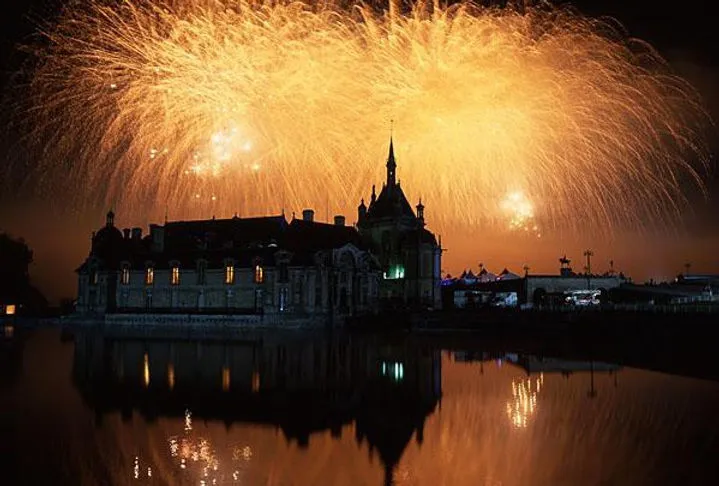
There are places where fireworks are not merely a festive occasion, but part of memory itself. In the Oise, pyrotechnics have found, for several centuries, settings worthy of them: from the parterres of Chantilly to the grand vistas of Compiègne, from princely celebrations to international competitions, the night sky becomes a stage. This history gives Masters de Feu a special depth. The event was not born ex nihilo: it belongs to a tradition in which fireworks engage in dialogue with architecture, gardens, music, crowds, and collective emotion.
Chantilly, the first stage of royal grandeur
To understand why the Oise can be seen as a land of fireworks, one must return to Chantilly. In the 17th century, the estate was one of the great settings for the display of aristocratic power. Louis II de Bourbon-Condé, known as the Grand Condé, welcomed the court there with a keen sense of spectacle. At that time, a fireworks display was not simply a closing entertainment: it was a political and aesthetic language. It spoke of the power of its patron, mastery of space, and the ability to dazzle.
The celebrations held in Chantilly in April 1671, on the occasion of the visit of Louis XIV, belonged to this culture of spectacle. Banquets, music, theatre, illuminations, and pyrotechnics formed an ensemble designed to impress the king and his court. The name of François Vatel, maître d’hôtel to the Grand Condé, has remained attached to those lavish days, as much for their refinement as for their tragic ending. In this world, fireworks held an emblematic place: they turned the gardens into a nocturnal theatre and inscribed the signature of a total celebration in the sky.
Le Nôtre, the gardens, and staging the sky
In Chantilly, pyrotechnics found an ideal partner: the composed landscape. The French formal gardens, water features, axes, perspectives, and façades offered fireworks designers a true natural dramaturgy. A display fired in such a setting does more than burst overhead. It responds to the lines of the park, is reflected in the water, reveals volumes, and highlights symmetries. This alliance of architecture, garden design, and light lies at the heart of the French tradition of open-air spectacle.
Fireworks thus become an art of composition. They require space, distance, sightlines, and rhythm to be considered. In the classical era, they celebrated the monarchy, alliances, victories, and major ceremonies. Later, they became a popular art, associated with national celebrations, urban gatherings, and major events. But the founding idea remains: to bring a crowd together around a brief, intense experience, impossible to reproduce exactly the same way twice.
Les Nuits de Feu, Chantilly’s great era
More than three centuries after the Grand Condé’s festivities, Chantilly reconnected with its pyrotechnic destiny through Les Nuits de Feu. Launched in the late 1980s in the prestigious setting of the estate, this event took the form of an international fireworks competition. For more than twenty years, it attracted fireworks houses from around the world and established Chantilly as one of Europe’s leading events of its kind.
Its success came from the rare combination of place, format, and artistic ambition. Les Nuits de Feu offered more than a succession of spectacular bouquets. They invited competitors to create true tableaux, often built around a theme, within an exceptional heritage setting. The public came for the performance, of course, but also for the privilege of seeing a historic site transformed by light. At their peak, these evenings drew enormous crowds, proof that pyrotechnics, when carried by a demanding stage language, can resonate far beyond the circle of enthusiasts.
2008, the end of a cycle and a void in the Oise sky
The final edition of Les Nuits de Feu, in 2008, marked the end of an era. The event’s discontinuation, linked notably to the withdrawal of financial support, left a visible gap in the cultural landscape of the Oise. The department then lost one of its great nocturnal landmarks, an event capable of bringing together heritage, tourism, artistic creation, and popular emotion. But the strongest traditions never disappear entirely: they often await a new place, new energy, a new format.
Between Chantilly and Compiègne, the continuity is geographical, but above all cultural. In both cases, the Oise offers fireworks designers a spectacular horizon and an audience accustomed to major outdoor gatherings. The disappearance of Les Nuits de Feu therefore does not close the pyrotechnic story of the department. On the contrary, it opens the possibility of a rebirth.
Compiègne takes up the torch with Masters de Feu
That rebirth took shape in 2016 with the creation of Masters de Feu at the Compiègne Hippodrome. The choice of venue is decisive. The hippodrome offers the scale, safety, open sightlines, and hospitality required for an event of this magnitude. It also makes it possible to bring together, in a single evening, the intensity of a major popular show and the precision of an international competition.
Masters de Feu extends the spirit of the great fireworks competitions while asserting its own identity. Here, the participating houses work within a shared framework: the same budget, the same show duration, the same imposed theme. This level playing field puts artistic writing at the forefront. What sets one competitor apart from another is not abundance of means, but the intelligence of the composition, the musicality, the diversity of effects, the precision of transitions, and the ability to create a lasting emotion.
A competition designed as a collective experience
The strength of Masters de Feu also lies in the place given to the audience. The spectator is not merely an awestruck witness; they take part in the spirit of the competition. The jury brings together public figures, professionals, and members of the public, while spectators can express their preference through the Audience Prize. This participatory dimension brings the event closer to major contemporary artistic competitions, where technical excellence is also measured by the intensity of the bond created with the audience — or, here, with the entire hippodrome.
The Masters format is built around a clear progression. Over three years, competitors vie for the Silver Master. The winners then meet again in a grand finale to compete for the Gold Master. In the longer term, the Platinum Master places the winners within an even rarer hierarchy of excellence. This structure gives the competition remarkable clarity: every edition matters, every victory builds a path, every final becomes a culmination.
From heritage to contemporary creation
What links the festivities of Chantilly, Les Nuits de Feu, and Masters de Feu is not only the use of powder and colour. It is a shared conviction: a successful fireworks display is a work of time, space, and emotion. It demands precise expertise, the highest safety standards, musical culture, a sense of rhythm, and vision. Behind the arcs, comets, candles, shells, and bouquets are teams, artistic choices, trials, weather constraints, and a constant pursuit of precision.
In Compiègne, this tradition finds a fully contemporary expression. Masters de Feu does not seek to reproduce Chantilly; it extends its momentum. The setting has changed, the audience too, technologies have evolved, but the ambition remains: to make the Oise sky an international stage. From Louis XIV to today’s spectators, from court festivities to an open competition for all, the luminous thread has never truly been broken. It continues to burn, each year, in this unique meeting of heritage, creation, and collective wonder.