Grand Final at the Gold Masters 2019: French elegance in the final
Just days before the 2019 Gold Master, Grand Final arrived in Compiègne as the winner of the 2018 Silver Master. Meet Pierre-Emmanuel Gélis and Stéphane Bazoge, two creators who champion a sensitive, precise and deeply musical approach to pyrotechnics.
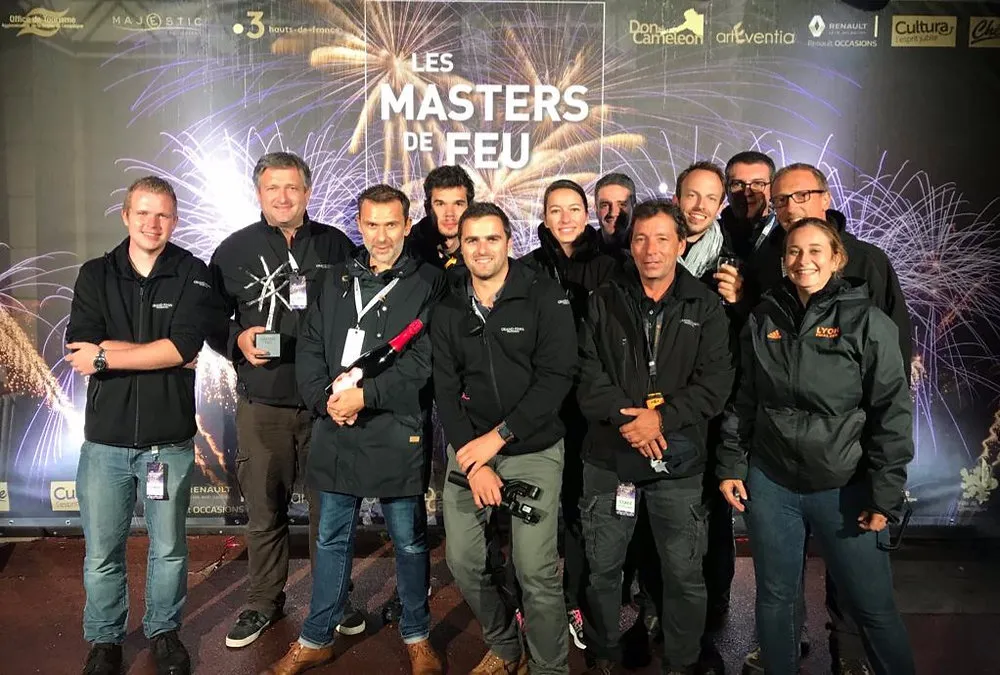
Ahead of the 2019 Gold Masters, Grand Final emerged as one of the most eagerly awaited contenders in the grand finale held at the Hippodrome de Compiègne. Winner of the 2018 Silver Master, the French house returned to the competition with a clear ambition: to defend a fireworks display conceived as a stage work, readable by all, exacting in its construction and generous in its emotion. Behind this signature stand two names: Pierre-Emmanuel Gélis and Stéphane Bazoge, founders of a company that has become, in less than ten years, a benchmark for major pyrotechnic events.
Grand Final, the return of a French laureate to Compiègne
In 2019, the Gold Masters brought together the winners of the three previous editions for a finale of exceptional calibre. Grand Final represented France, after winning the 2018 Silver Master. For a French company, returning to Compiègne in this context carried a singular resonance: the sense of a home fixture, but also a confrontation with other pyrotechnic cultures, other styles of writing, other ways of bringing music, rhythm and colour into dialogue.
Pierre-Emmanuel Gélis and Stéphane Bazoge did not approach this final as a display of force. Their approach was more subtle: to remain faithful to what they do best, without giving in to the temptation of gratuitous technical virtuosity. In their view, fireworks only make sense when they become accessible, elegant and sincere. Masters de Feu thus offered them an ideal stage to return to the essentials of the craft: creating a show that speaks to the audience, without losing the artisanal precision that sets the great houses apart.
Two complementary paths behind a distinctive signature
Grand Final was founded in 2010 by Stéphane Bazoge and Pierre-Emmanuel Gélis. Their careers did not follow the same trajectory, and it is precisely this complementarity that shapes their approach. Pierre-Emmanuel Gélis comes from a business school background and discovered the world of fireworks during a final-year internship, before staying in the field for a decade. Stéphane Bazoge, meanwhile, studied law, the Institut français de Presse and sports event management, before discovering pyrotechnic shows in the late 1990s.
This dual culture is reflected in the way Grand Final designs its projects. On the one hand, there is a commitment to production, safety, organization and reading the site. On the other, a clear taste for storytelling, rhythm, imagery and dramaturgy. The company does not claim only technical firework expertise: it champions a true writing of fire, in which each effect must find its place, its breath and its purpose.
From major international stages to the Compiègne racecourse
Less than ten years after its launch at the time of this interview, Grand Final had already signed or supported projects on very different stages: the Cannes Film Festival, national celebrations from Grenoble to Mexico City, the Champions League and Europa League finals, and the opening ceremonies of the African Games. This diversity says a great deal about their craft. A pyrotechnic show is not designed in the same way in a stadium, on an architectural façade, by the water, or on a vast open site such as the Compiègne Racecourse.
For Pierre-Emmanuel Gélis and Stéphane Bazoge, every venue imposes its own balance. One must work with technical constraints, budget, safety distances, audience perception, but also with the artistic potential of the site. A stadium calls for power, immediate readability, collective celebration. An architectural setting may invite graphic precision and the enhancement of volumes and lines. An open space, by contrast, requires thinking about the horizon, depth, and the relationship to the sky. In Compiègne, the challenge was therefore to turn the racecourse into a nocturnal stage, without losing the intimacy of the viewing experience.
The refusal of the simple finale bouquet
When asked what makes fireworks stay in the memory, Grand Final does not reduce the answer to the finale bouquet. This stance is telling. The finale can impress, make the ground vibrate, and spark an ovation. But a great show is not defined by its last few seconds. What remains, in their view, is the overall impression: the way the narrative has been sustained, the coherence of the tableaux, the contrasts, the pauses, the successive emotions.
In this vision, pyrotechnics meets the performing arts. A memorable show does not merely accumulate effects; it creates a progression. It surprises without disorienting. It allows for pauses, surges, striking images and more suspended moments. It may rely on a spectacular sequence, such as revealing an architecture or a highly choreographed ascent, but above all it must deliver an overall emotion. That is the impression Grand Final sought to leave at the Gold Master 2019.
Music as the backbone of the show
At Grand Final, music is not an afterthought. It structures the creation. Pierre-Emmanuel Gélis describes it as the element that drives the movement; Stéphane Bazoge emphasizes its ability to guide, set the rhythm and surprise. This central role given to the soundtrack explains the precision sought in synchronizations, as well as the desire to create an experience deeper than a simple sequence of coloured explosions.
Music gives fireworks a particular sense of time. It builds anticipation, triggers surprise, amplifies contrasts. Combined with pyrotechnics, it can erase the ordinary measure of time: a few minutes become an emotional journey, a succession of tension and release. For a competition such as Masters de Feu, where the audience and the jury assess technical mastery as much as artistic intent, this dialogue between sound and light becomes decisive.
Simple, accessible and elegant pyrotechnics
What stands out in the answers from Pierre-Emmanuel Gélis and Stéphane Bazoge is their commitment to a certain clarity. The word “simple” does not mean poor or easy; rather, it refers to the legibility of the gesture. A successful pyrotechnic show must be understandable to a very broad audience, while offering connoisseurs the finesse of technical and musical choices. On the contrary, this simplicity calls for great mastery: knowing what to remove, how much to add, how to prioritize, and not saying everything at once.
Elegance, another key word in their vocabulary, is expressed through proportion. It emerges in the choice of colors, in the breathing space between sequences, and in the refusal of systematic excess. Grand Final embraces pyrotechnics that can be spectacular without becoming showy. This approach, already evident in their international journey, found a particularly coherent setting at the Gold Master: that of a competition where fireworks are judged as writing, not only as a feat of skill.
Passing on the desire to make fire a profession
Asked what advice they would give a young enthusiast dreaming of becoming a fireworks technician, the founders answer with humor and openness: vocations are welcome at Grand Final. Beneath the phrase lies another reality of the industry. Pyrotechnics is a profession of passion, but also of discipline, long apprenticeship, absolute safety and constant curiosity. It calls for the ability to dream big while mastering the most concrete details.
Published ahead of the 2019 Gold Master, this interview also shows Grand Final at a pivotal moment: a French house already widely recognized, strengthened by international experience, yet still driven by the desire to champion an artisanal and sensitive vision of the pyrotechnic spectacle. In Compiègne, Pierre-Emmanuel Gélis and Stéphane Bazoge were not simply coming to seek a trophy. They were coming to remind us that a fireworks display, when conceived with precision, can become a shared story, an architecture of emotion and a lasting memory in the sky.