How is a fireworks display judged in competition?
In a pyrotechnic competition, a fireworks display is judged on far more than its grand finale: it is read as a complete work, with its music, rhythm, precision and emotion. At Masters de Feu, the jury assesses each show according to criteria that distinguish the pyrotechnicians while leaving an essential place for the audience’s sensitivity.
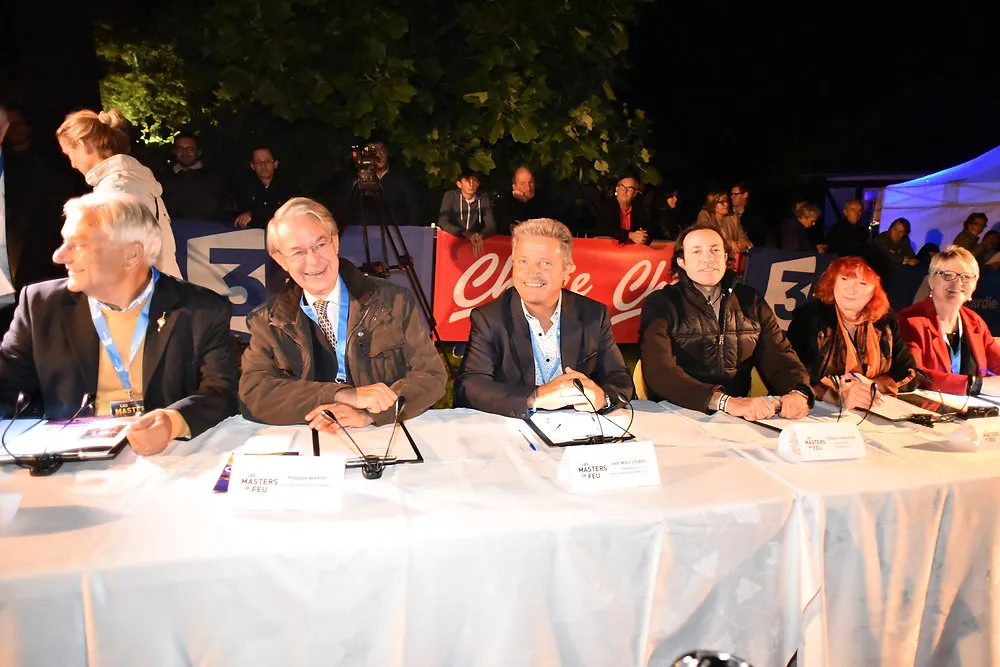
Evaluating fireworks means learning to see differently. The spectator first admires the brilliance, the colour, the collective thrill that runs through the crowd when a burst opens above the racecourse. The jury, however, observes the same magic with a more methodical eye: it listens, compares, dissects, and appreciates the overall coherence. In an international pyrotechnic competition such as Masters de Feu in Compiègne, each performance is conceived as a complete creation, where technique serves an artistic intention and where even a single second can make the difference.
A competition fireworks display is a work of art, not merely a succession of effects
The first instinct is to move beyond the idea of fireworks as an accumulation of spectacular rockets. In competition, the pyrotechnician is not seeking only to impress with power or quantity. They must tell a story. The show has an opening, moments of breathing space, rising tension, breaks, sometimes silences, and then a finale. Like a choreography or a symphonic score, the whole must hold together from the first tableau to the last.
The jury is therefore interested in the overall construction. Is the show readable? Is the artistic intention clearly expressed? Do the sequences follow one another naturally? A very beautiful isolated effect is not enough if the rest feels disjointed. Conversely, a more subtle performance can leave a strong impression when it offers a coherent world, a controlled progression, and a true visual signature.
Musical synchronisation, the backbone of the show
In major contemporary competitions, music is central. It is not just a soundtrack: it guides the rhythm, inspires the colours, dictates the accelerations and pauses. One of the main evaluation criteria is therefore the alignment between sound and image. The explosions, comets, candles, mines, and bouquets must converse with the soundtrack, without giving the impression of a sequence pasted on afterwards.
Successful synchronisation is noticeable in both major accents and fine details. An effect bursting exactly on a percussion hit, a rise of bursts accompanying an orchestral build, a rain of gold extending a sustained note: these choices reveal the precision of the preparatory work. Modern firing systems allow for remarkable finesse, but technology does not replace musical sense. What the jury seeks is the right balance between pyrotechnic mechanics and sonic emotion.
Originality: surprising the audience without losing them
Originality is among the most difficult criteria to assess, because it is not limited to a rare or spectacular effect. To innovate in pyrotechnics may mean using an unexpected colour palette, playing with height, working on symmetry, introducing a more graphic sequence, or daring a change of tempo where a classic build-up would be expected. The jury values proposals that break from convention while remaining understandable to the audience.
Surprise must make sense. An unusual tableau, if it does not fit into the rest of the show, can seem gratuitous. By contrast, a well-introduced idea gives the performance a strong identity. In a competition where several pyrotechnicians work under comparable conditions, originality becomes a way of revealing a culture, an aesthetic, a personal way of inhabiting the sky. That is often where the difference emerges between a very solid performance and a truly memorable show.
The diversity of effects and technical mastery
A top-level fireworks display relies on a wide variety of effects: round openings, palms, willows, peonies, strobes, comets, volcanoes, ground sequences, fans, crossings, gradients, sound effects, or more restrained tableaux. The jury observes the richness of this palette, but also the way it is used. Multiplying effects is not enough; they must be arranged intelligently.
Technical mastery is judged through several signs: the clarity of the shapes, the regularity of the trajectories, the precision of the launches, the cleanliness of the transitions, the use of space, the management of height, and the quality of the finale. A well-designed show uses the sky like a stage. It can explore depth, alternate very wide moments with more intimate sequences, and play with diagonals or symmetry. For a jury, this mastery reveals the quality of the writing as much as that of the execution.
Overall aesthetics: colour, rhythm and clarity
Overall aesthetics refers to the visual impression left by the whole. Are the colours harmonious? Are the tableaux legible? Do the effects answer one another with elegance? Does the rhythm avoid monotony? A good fireworks display knows how to breathe. It does not have to be dense at all times. Well-judged moments of anticipation strengthen the impact of the sequences that follow.
The jury also looks at how the duration is managed. A performance can lose intensity if it reveals its strongest effects too early or maintains the same level of power without variation. Conversely, a progressive construction, capable of alternating softness, tension, brilliance and calm, creates a more complete experience. The finale remains important, of course, but it should not overwhelm everything that came before. It must conclude, not compensate.
Emotion, an essential criterion impossible to reduce to a formula
Even within a scoring framework, emotion remains decisive. A fireworks display can be technically flawless and still leave a cold impression. Another, more daring or more poetic, can move the audience through its sincerity. Jurors therefore also evaluate what cannot be fully measured: the show’s ability to spark momentum, a moment of admiring silence, surprise, and collective joy.
This is why juries for pyrotechnic competitions often bring together varied profiles. At Masters de Feu, the perspective of figures from the arts, live performance, culture, or local life can be combined with that of members of the general public chosen at random. This blend is valuable: it prevents the judgment from being reduced to a purely technical reading and reminds us that fireworks exist first and foremost to be experienced.
A scoring system akin to that of an artistic discipline
The evaluation of fireworks is sometimes compared to figure skating. The comparison is apt: there is a part of execution, a part of composition, and a part of interpretation. Pre-established criteria provide a common framework so that every competitor is assessed according to the same reference points. Then each juror expresses their sensitivity through their score.
This method makes it possible to distinguish between shows that may be very different in style. Some pyrotechnicians favour power and rhythmic precision; others rely on poetry, colour, the finesse of transitions, or narrative. The jury’s role is not to impose a single taste, but to recognise the most accomplished performance in light of the theme, the constraints, and the emotion generated.
The audience’s view, another verdict
In a competition such as Masters de Feu, the audience is not merely a witness. It helps shape the atmosphere of the evening and can also express its preference through the Public Prize. This distinction carries particular value: it rewards the show that most directly moved the spectators, the one people talk about as they leave the stands, the one that remains in conversations and memories.
The audience’s verdict does not always match the jury’s, and that is precisely what makes the competition so compelling. Jurors may distinguish a highly refined composition or remarkable technical control, while spectators may be swept away by a more immediate emotion. These two perspectives do not conflict: they complement one another. Together, they give fireworks their dual nature, both a precision art and a popular celebration.
Why these criteria are essential to Masters de Feu
Masters de Feu is built on a principle of fairness: the same framework, the same theme, the same show duration for all competitors. Under these conditions, the evaluation criteria make it possible to compare what can be compared, without erasing the personality of each fireworks house. They give the competition its rigour and strengthen the value of the distinctions awarded from one edition to the next, from Silver Master to Gold Master, and on towards Platinum Master.
For spectators, understanding these criteria enriches the experience. One still allows oneself to be amazed, but one also better understands what is unfolding in the sky: the precision of a launch, the elegance of a sequence, the power of a silence, the intelligence of a finale. Evaluating fireworks does not mean stripping the show of its enchantment. On the contrary, it reveals the full extent of the work, culture, and inventiveness needed to turn a few minutes of light into an unforgettable moment.