Before fifteen minutes of showtime, several months of creation
At Masters de Feu, the show does not begin when the first shell leaves its mortar. It begins several months earlier, in the workshops of the international teams. Music, theme, storyboard, simulations, programming… discover the backstage of a creation where every detail counts before winning over the audience and the jury.
On the evening of Masters de Feu, everything seems simple.
The lights go down, the music rises, the sky ignites and, for fifteen minutes, the audience forgets everything and lets itself be carried away by a creation from the other side of the world.
A few moments later, the applause breaks out, the show ends and everyone leaves with their emotions.
But what spectators often do not realize is that this fifteen-minute interlude is the result of months of thought, creation and work.
Because a Masters de Feu show is not born in Compiègne.
It comes to life long before, in the workshops of the pyrotechnicians.
A competition that transforms the way of creating
Designing fireworks for a national celebration, a festival or a major popular event follows a well-known logic: to captivate the audience.
In an international competition, the challenge is entirely different.
Of course, you must dazzle thousands of spectators, but you must also convince a jury, surprise your rivals and assert a truly distinctive artistic signature.
The goal is no longer simply to stage a beautiful show. It is about telling a story.
It is this level of demand that makes international pyrotechnic competitions true laboratories of creation, where pyrotechnicians experiment with new forms of expression, take greater artistic risks and push the boundaries of their craft.
It all begins... with a blank page
Contrary to what one might imagine, the first weeks are not devoted to fireworks.
Before thinking about colors, calibers or effects, each team must find the guiding thread of its creation.
At Masters de Feu, however, all teams start from the same point.
For this tenth edition, they were given a single theme:“The Grand Ball”.
A simple instruction at first glance. And yet...
From these two words, each country will build a completely different universe.
Some will choose the grace of an imperial ball, others will tell the story of a popular celebration, a dream or a more contemporary tale.
That is the true richness of the competition: one and the same inspiration gives rise to shows that are never alike.
When music writes the show
Long before the first simulations, pyrotechnicians spend hours listening to music. Dozens of pieces, sometimes hundreds.
They seek less a melody than a language capable of carrying their story, a crescendo, a silence, a break, a breath.
For in a pyrotechnic show, music does not merely accompany the images. It dictates their rhythm.
It determines the intensity, the pace, the pauses and the emotions.
Each firework launch then becomes one more note in a score written for the sky.
Writing with light
Once the soundtrack is finally chosen, a much more discreet process begins. Sheets fill with sketches. Plans take shape.
Simulation software makes it possible to imagine volumes, heights, colors and synchronizations.
Each sequence is tested, moved, corrected, sometimes completely reimagined.
And yet no experienced pyrotechnician relies entirely on a simulation.
Wind, smoke, the contours of the site or the audience perspective always alter the final result. The software shows what could happen.
Experience makes it possible to imagine what will actually happen.
The challenge is not to add...
It is often to take away.
The finest shows are not necessarily those that use the most fireworks.
They are the ones that know how to create breathing space, introduce silence, let an emotion emerge before returning to the power of a final burst.
In competition, every second counts, every transition is observed, every effect must have a purpose.
This constant search for balance explains why teams sometimes spend several months perfecting a creation that will ultimately last only a quarter of an hour.
Behind the show, thousands of decisions
Once the scenario has been definitively set, a new phase begins.
Each effect is positioned with precision, each firing cue is programmed, each sequence is synchronized to within a hundredth of a second with the soundtrack.
At the same time, the teams organize the international transport of the fireworks, prepare their equipment, coordinate logistics and anticipate their installation in Compiègne.
The competition has already begun, only no one can see it yet.
Then finally comes Compiègne
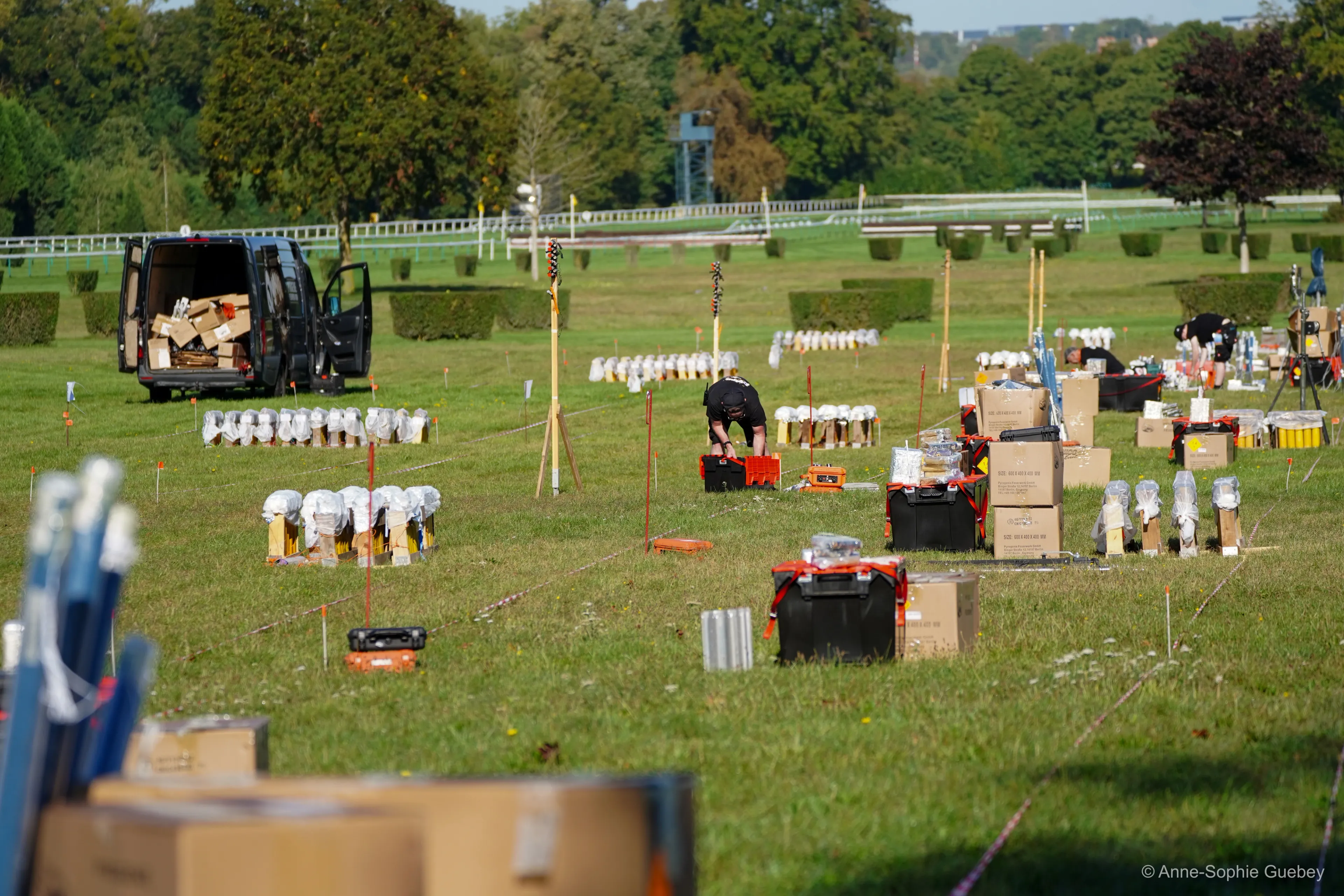
A few days before Masters de Feu, the teams arrive at the racecourse. While the public goes about its daily life, the pyrotechnicians take over the site.
The mortars are put in place.
Kilometers of cables gradually connect the different firing zones.
The ignition systems are installed, tested and then checked one last time.
The show, imagined months earlier hundreds, sometimes thousands of kilometers from France, finally becomes reality.
Fifteen minutes to convince
When evening comes, all that remains is to wait. The first firing marks a special moment for each team. From then on, nothing can be corrected, modified or improved.
The show now belongs to the audience.
And for fifteen minutes, months of work, dozens of professionals and thousands of decisions become one. Perhaps that is, in the end, the magic of Masters de Feu. What the audience admires in the sky is not just a fireworks display.
It is the result of a human, artistic and technical adventure that began long before the pyrotechnicians set foot in Compiègne.