The most beautiful New Year’s fireworks in the world
From Sydney to Rio, via Dubai, London, Taipei, Montreal and Paris, the arrival of the new year gives rise to pyrotechnic shows that have become iconic. Here is a non-exhaustive overview of these celebrations where light, music and monuments create a universal emotion.
Every December 31, the world changes year across successive time zones, and major cities compete in imagination to mark this shift with light. New Year’s Eve fireworks are not just a finale: they are a global postcard, a ritual of gathering, a technical and artistic display watched by millions, both on site and at a distance. This deliberately non-exhaustive selection highlights a few shows that have become iconic for their setting, scale, or pyrotechnic writing.
New Year’s Eve, the world stage of pyrotechnics
Unlike fireworks fired for a national holiday or a local event, New Year’s Eve displays must meet a universal expectation: to make it feel, in just a few minutes, that something is beginning. Pyrotechnicians therefore work to a very particular tension. They must accompany the countdown, surprise the audience in the first seconds after midnight, occupy the space, engage with a skyline, a river, a bay, or a monument, and then leave a powerful image in collective memory. Success depends as much on the force of the effects as on the precision of the rhythm, the clarity of the colors, the choice of firing points, and the intelligence of the setting.
The most beautiful New Year’s fireworks often have one thing in common: they do more than light up the sky. They turn the city itself into a stage. A bridge becomes a launch ramp, a tower turns into a column of light, a seafront becomes a natural amphitheatre. It is this alliance between architecture, geography, and pyrotechnic creation that sets the great international events apart.
Sydney: the ultimate icon of fireworks on the bay
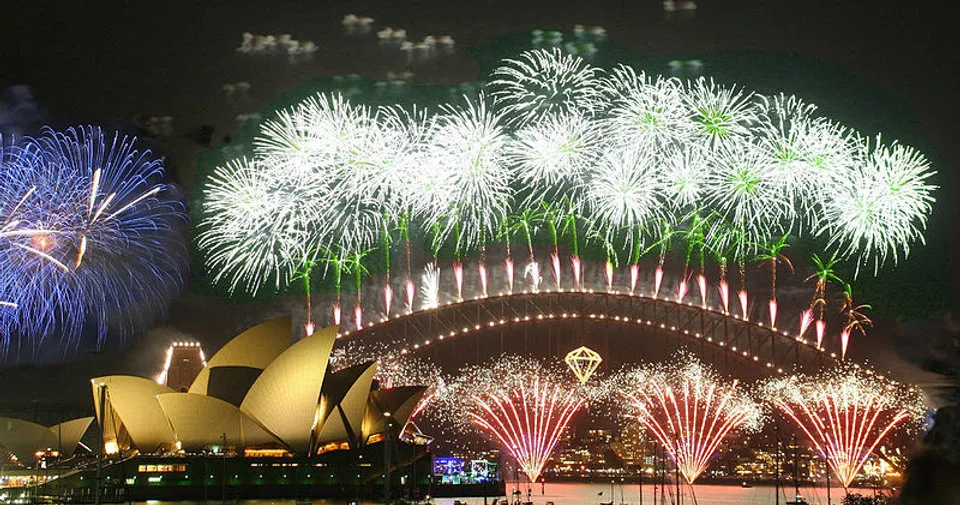
Sydney is one of the first major urban spectacles to kick off the global New Year’s celebrations. Its bay, the Harbour Bridge, and the Opera House create an almost perfect setting: open, monumental, instantly recognisable. Crowds gather along the shores, in the parks, on boats, and at the many viewpoints around the harbour. The tradition generally features an early evening fireworks display for families, followed by the main midnight show.
What stands out in Sydney is the panoramic scale of the production. The effects are not concentrated in a single point: they unfold around the bridge, the barges, the Opera House, and the waterfront, creating striking depth. Pyrotechnicians play with the width of the bay, reflections on the water, and the steel silhouette of the Harbour Bridge. The result often gives the impression of a 360-degree display, with a highly legible signature: broad bursts of color, synchronised sequences, and a finale designed to be seen as clearly from the quays as by cameras around the world.
Dubai: the spectacular verticality of the Burj Khalifa
In Dubai, New Year’s Eve has become a statement of contemporary excess. The Burj Khalifa, the tallest tower in the world, imposes a vertical dramaturgy that few sites can offer. The show combines fireworks, lighting, screens, lasers, and urban staging around Downtown Dubai. Where Sydney works with the breadth of the bay, Dubai exploits height, slenderness, and the sensation of a monument blazing floor by floor.
Here, fireworks are conceived as a total event. The effects rise along the tower, interact with luminous façades, and answer each other between sky and architecture. The spectator is not simply attending a pyrotechnic display: they are watching a city assert its identity through technology, precision, and brilliance. This hybrid approach, at the crossroads of fireworks, light, and multimedia show, has helped establish Dubai as one of the essential destinations for December 31.
London: the Thames, the London Eye, and the art of tempo
London has another major asset: the theatricality of the Thames. The New Year’s Eve display, organised around the London Eye and the central embankments, plays with one of Europe’s most famous urban landscapes. The river acts as a mirror, the Ferris wheel becomes a perfect circular motif, and the surrounding monuments give the show both a popular and institutional dimension.
London’s strength lies in its sense of tempo. The sequences are generally very musical and highly structured, with an alternation of dense effects, pauses, and surges of intensity. The firing must adapt to a tightly controlled urban space and a very large crowd, which requires strict organisation. For the public, the experience is carefully prepared: viewing areas are controlled and access has been ticketed in recent major editions. This constraint does nothing to diminish the magic of the moment; it simply reminds us that a world-class pyrotechnic show is also a logistical feat.
Taipei, Rio, and Montreal: three ways to make the night resonate
In Taipei, the New Year’s fireworks are inseparable from Taipei 101. The tower becomes a graphic instrument, a landmark that draws the attention of the entire city. Fireworks burst from the structure, overlay the light animations, and create a highly vertical score. This kind of show requires exceptionally precise writing: every effect must respect the building’s scale, its readability from a distance, and its synchronisation with the music or visual content. Taipei has thus become one of the most recognisable images of the Asian New Year.
In Rio de Janeiro, the experience is radically different. The setting is not a tower, but a mythical beach: Copacabana. The crowd, often dressed in white according to local tradition, gathers facing the ocean. Firings from barges offshore allow the curve of the coastline to be embraced and the fireworks to converse with the waves. Emotion comes as much from the human scale as from the magnitude of the spectacle: music, crowd, sea, sand, open sky. Rio reminds us that pyrotechnics are also an art of collective celebration.
Montreal offers a more wintry, more North American version, centred on the Old Port and the Saint Lawrence River. Here, the fireworks stand out in the cold air, above a landscape of stone, ice, and urban lights. The pyrotechnics are often part of a broader evening featuring concerts, countdowns, and a grand gathering atmosphere. The contrast between the warmth of the crowd and the severity of winter gives the show a very distinctive tone, more intimate than that of oceanfront megacities, yet equally memorable.
Paris: the Eiffel Tower, a defining memory of the year 2000 transition
It is impossible to speak of the great New Year’s fireworks without thinking of Paris. The French capital has not always made December 31 a pyrotechnic event as regular as Sydney or London, but certain images remain unforgettable. The transition to the year 2000, with the show created on the Eiffel Tower by Groupe F, remains a major moment in the recent history of monumental pyrotechnics in France. The Iron Lady, a global symbol, was transformed into a structure of fire and light on the scale of the event.
This memory says a great deal about the power of monuments in pyrotechnic art. A successful fireworks display depends not only on the number of shells or the length of the show. It depends on the meaning given to the place. In Paris, the Eiffel Tower’s verticality, its metal lattice, and its universal imagination make it possible to create images that are instantly part of our heritage. When fireworks embrace an architecture known to all, they go beyond entertainment to become a moment of visual history.
What makes a New Year’s fireworks display truly unforgettable
The beauty of a major New Year’s fireworks display rests on a subtle balance. Technical mastery is essential, of course: safety, distances, weather, synchronisation, precision of angles, and reliability of firing systems. But artistic intent is just as important. The greatest shows tell a progression. They begin by capturing attention, establish a color, a rhythm, or a motif, and then build emotional momentum toward the finale.
At this scale, fireworks become an international language. Spectators may not speak the same language, live in the same climate, or celebrate the same traditions, but they all immediately understand the wonder of a sky opening at midnight. That is precisely the emotion that Masters de Feu celebrates in Compiègne: the talent of pyrotechnicians, pyromusical writing, the precision of gesture, and the ability of a show to bring people together. From the Harbour Bridge to the Eiffel Tower, from Copacabana to the Burj Khalifa, the most beautiful New Year’s fireworks remind us of one truth: pyrotechnics are an art of the sky, but above all an art of sharing.