Las Fallas de Valencia: the other world capital of fire
Every March, Valencia turns pyrotechnics into a popular language with Las Fallas, a street festival of satire and fire inscribed on UNESCO’s Intangible Cultural Heritage. For Masters de Feu, this Spanish celebration also echoes the memory of Pirotecnia Caballer, the Valencian house invited to the inaugural edition in Compiègne in 2016.
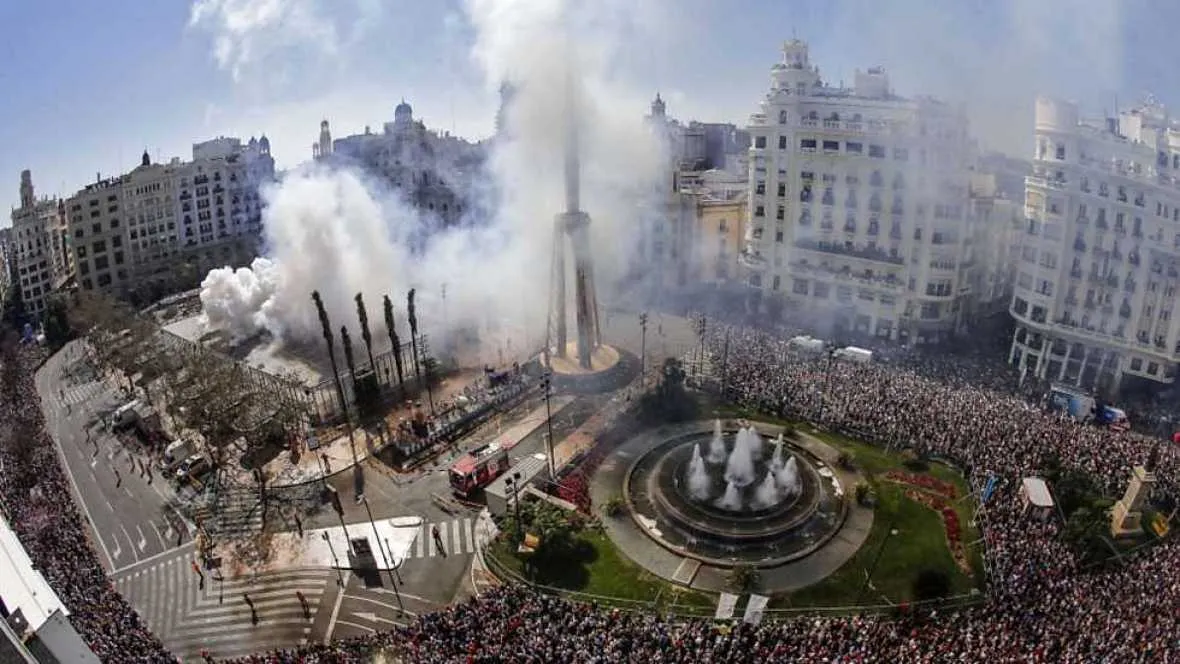
In Valencia, fire is not just a spectacle: it is a culture, a rhythm, almost a way of inhabiting the city. Every March, Las Fallas de Valencia bring ephemeral monuments to the streets, vast crowds, fanfares, the scent of gunpowder and that singular tension before the final blaze. For Masters de Feu, the international pyrotechnic competition held in Compiegne, this great Valencian gathering carries a special resonance: in 2016, at the first edition, Pirotecnia Caballer, from the Valencia region, captivated the public with a luminous, poetic composition.
Valencia, a city of fire as much as of light
Las Fallas, or Les Falles in Valencian, are among Spain’s most celebrated popular festivals. Their heart beats around Saint Joseph’s Day, on March 19, a date linked to the patron saint of carpenters. In the fallero imagination, this artisanal origin remains essential: the ancient gestures of wood, workshop, construction and combustion continue in an urban celebration of exceptional scale. The most intense days traditionally run from March 15 to 19, even though the fallas atmosphere reaches Valencia well before, notably through the daily pyrotechnic events that set the pace of early March.
What strikes the outside observer is the central place given to fire in all its forms. Fire is sound in the mascletà, visual in the night displays, symbolic in the cremà, social in the neighborhoods gathered around their fallas. Where many festivals use pyrotechnics as a finale, Valencia builds them into the very dramaturgy of the event. Gunpowder is not a mere effect: it is punctuation, a signature, a collective breath.
The fallas: monuments born to disappear
The word falla refers at once to the festival, the group behind it and the monument installed in public space. These spectacular constructions, made up of figures called ninots, are imagined by local artists and craftsmen. They comment on current events, satirize the powerful, stage the flaws of an era or develop fantastical worlds of remarkable visual richness. For a few days, squares and streets become an open-air museum: abundant, popular, satirical and temporary.
This ephemeral dimension gives Las Fallas their emotional force. Everything is designed to be seen, photographed, discussed, admired, and then destroyed. The beauty of the work done is not meant to last, but to culminate in the instant it is set alight. The cremà, on the night of March 19, turns the monuments to ash and closes the cycle. This act is not only spectacular: it evokes renewal, purification, the end of winter and the opening toward spring. The city burns so that it may begin again.
The mascletà, an art of rhythm and power
For pyrotechnics enthusiasts, the mascletà is one of the most fascinating emblems of Valencian culture. Unlike a firework display designed mainly for color and height, the mascletà is about sound, intensity, progression and vibration. It is built like a score: a measured beginning, a build-up of power, call-and-response sequences, accelerations, an earthly and aerial finale. The body feels as much as it watches. Facades tremble, the square holds its breath, then the roar turns into applause.
This relationship to rhythm speaks directly to Masters de Feu, where pyrotechnicians are judged not only on the beauty of their effects, but also on their ability to compose with music, control tempo and create an emotion readable from a large open-air space. The Valencian tradition reminds us that pyrotechnics are never just a matter of products or calibres. They are about an intelligence of time: knowing when to surprise, when to suspend, when to release energy.
Pirotecnia Caballer, a bridge to Compiegne
In the history of Masters de Feu, the mention of Las Fallas naturally brings us back to Pirotecnia Caballer. The company, from the Valencia region, belongs to a territory where pyrotechnics are at once industry, craft, popular art and living heritage. Its presence in Compiegne in 2016, during the competition’s first edition, allowed the French public to discover a different sensibility: a fire conceived with Iberian refinement, precision in sequencing and that taste for luminous poetry that turns the sky into a stage.
The aim was not to recreate Las Fallas in Compiegne, but to let their spirit be felt: a deeply rooted, transmitted, demanding fire culture, capable of combining power and delicacy. In an international competition, the diversity of pyrotechnic schools is essential. Italian, Spanish, French, Portuguese, Japanese or other traditions do not tell the story of fire in the same way. That pluralism is precisely what gives Masters de Feu its appeal: each show carries an accent, a memory, a way of moving an audience.
A festival recognized as intangible cultural heritage
The inscription of the Fallas de Valencia festival on UNESCO’s Representative List of the Intangible Cultural Heritage of Humanity on November 30, 2016, confirmed a reality already obvious to Valencians: Las Fallas are not merely a tourist event. They bring together multiple forms of know-how, from fallero artists to musicians, embroiderers to pyrotechnicians, neighborhood committees to the families who prepare for the event all year round. The festival mobilizes an entire city and sustains a collective relationship to creation, satire and fire.
This recognition also highlights the role of pyrotechnics in living heritage. Fire is not decorative here: it structures the key moments, gives intensity to gatherings, accompanies rituals and contributes to the festival’s identity. For professionals, Las Fallas are a laboratory of excellence. For the public, they offer a rare immersion in a world where emotion is born as much from sound as from color, as much from anticipation as from the blaze.
What Masters de Feu shares with the fallero spirit
In Compiegne as in Valencia, fire captivates because it is fragile and monumental at once. A pyrotechnic show requires months of preparation, rigorous technical expertise, impeccable safety and a clear artistic vision. Yet everything is decided in just a few minutes, before an audience that sees only the result: the perfect trajectory, the unfolding color, the harmony with music, the finale that lifts the crowd.
Masters de Feu extends this same fascination in the setting of an international competition. The participating companies are given a defined time, a theme and a shared space; they must win over the audience through their aesthetics, timing, originality and the emotion they create. Over the years, the distinctions Silver Master, Gold Master and Platinum Master have embodied this pursuit of excellence and recognition among leading pyrotechnicians. Las Fallas, in turn, remind us where part of this passion comes from: the street, the workshops, the neighborhoods, popular transmission.
An event to be experienced with the eyes and with the body
To see Las Fallas de Valencia is to accept a total experience. You walk a great deal, stop in front of extravagant monuments, listen to fanfares, let yourself be surprised by firecrackers, wait for the mascletà amid dense crowds, then discover a city transformed by night. The festival can be intense, noisy, sometimes disorienting, but it is precisely this sensory force that makes it unique.
For fireworks lovers, Las Fallas are an essential journey. For Masters de Feu spectators, they offer an additional way of reading the event: behind every luminous tableau lies a culture, a school, a history of pyrotechnic craft. From Valencia to Compiegne, fire thus travels as an international language. It brings people together, surprises, moves — and, when mastered by the greatest pyrotechnicians, becomes art.