Masters de Feu 2017: Brussels, London and Athens in the spotlight
On September 8, 2017, the second edition of Masters de Feu brought together three European houses at the Compiègne racecourse for the Silver Master. Belgium, England and Greece were to translate “The Secrets of European Capitals” into music and light.
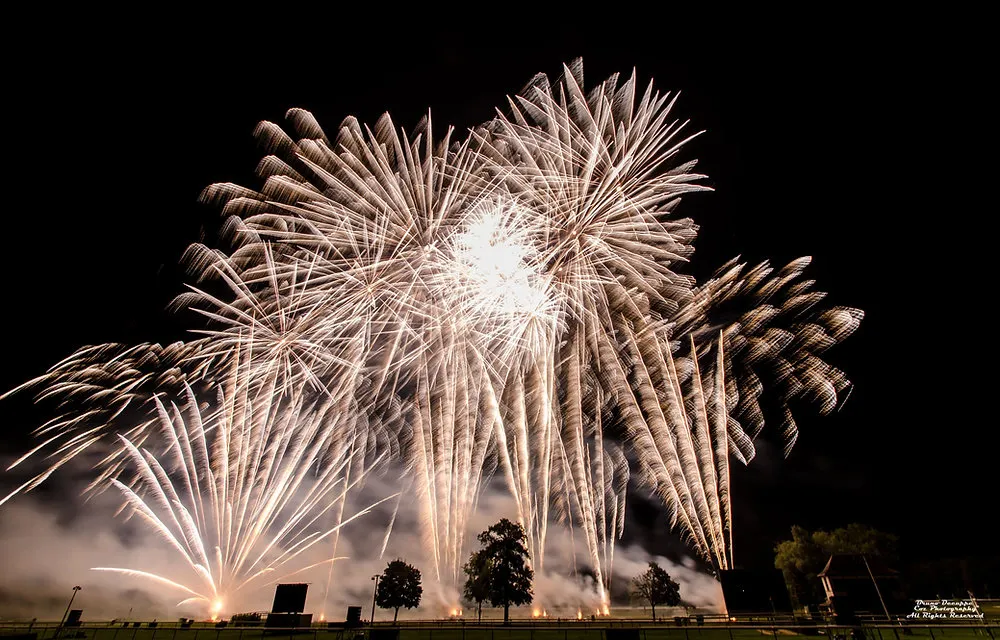
On Friday, September 8, 2017, the Masters de Feu invited the public to the Compiègne racecourse for a second edition under the sign of travel, culture, and pyrotechnic excellence. After a widely praised first year, the international competition confirmed its ambition: to bring together, for one evening, three of the strongest pyrotechnic companies on the European scene and set them apart on a shared theme. More than 12,000 spectators were expected for this second round, where Belgium, England, and Greece would compete in visual writing, musical precision, and emotion to claim the 2017 Silver Master.
A second edition already eagerly awaited in Compiègne
From its creation in 2016, the Masters de Feu established an unusual format in Compiègne: a competition concentrated into a single evening, in one venue, with three shows in competition and a genuine artistic stake. The event belongs to the great tradition of fireworks competitions, but with a structure that is clear for the public: each qualifying year reveals a Silver Master, set to meet the other winners in a grand final for the Gold Master. This cycle gives each edition particular weight. It is not simply a matter of attending a succession of fireworks displays, but of discovering worlds, comparing signatures, and watching a finalist emerge.
The first edition had drawn a large audience, from the Oise, Hauts-de-France, neighboring regions, and sometimes farther afield. For 2017, expectations were therefore high. The Compiègne racecourse once again became a vast open-air stage, capable of welcoming both families and seasoned pyrotechnics enthusiasts. The evening promised a complete experience: doors opening late in the day, musical atmosphere, a gradual rise in light, and then the start of the competition after nightfall.
“The Secrets of European Capitals,” a theme made for the imagination
For this second round, the competitors had to create around an evocative theme: “The Secrets of European Capitals.” The subject offered exceptionally rich creative ground. A capital is never just a backdrop. It carries history, architecture, collective memory, sounds, myths, ruptures, and symbols. In around fifteen minutes, each team had to transform this cultural material into a pyromusical narrative that was understandable, moving, and spectacular.
The theme called for a form of narrative elegance. It was not enough to line up powerful effects or impressive bouquets: it was necessary to suggest a city, an atmosphere, a character. Through color, rhythm, height, density, and musical synchronization, the pyrotechnicians had to translate what Brussels, London, or Athens can evoke in the European imagination. This kind of exercise reveals the difference between a technically successful fireworks display and a true pyrotechnic creation: fire then becomes language, punctuation, breathing space, and dramaturgy.
Belgium represented by HC Pyrotechnics
Belgium was represented by HC Pyrotechnics, with Cliff Hooge in charge of the design. The choice of Brussels naturally echoed the theme. The Belgian capital, but also a European institutional crossroads, Brussels offers a contrasting material: a city of historic facades, monumental squares, humor, surrealism, administrative modernity, and popular conviviality. For a pyrotechnician, this diversity can be translated into very different tableaux, alternating refinement, urban energy, and more unexpected nods.
In a competition like the Masters de Feu, the challenge is to establish an identity in just a few minutes. A pyrotechnic house must assert its style from the opening sequences while still allowing for progression. Close-range effects, vertical rises, musical breaks, and palette changes all become tools to hold the audience and convince the jury. HC Pyrotechnics thus arrived with the mission of giving Brussels a strong luminous presence, both clear and personal.
Smart Pyrotechnics for England and the spirit of London
England entered the competition with Smart Pyrotechnics, led by designer Steve Martin. For a pyromusical show, London is an especially vast source of inspiration. A royal city, a pop capital, a financial metropolis, a setting for major historical and cultural narratives, it allows for a contrast-rich composition, between solemnity, speed, elegance, and contemporary intensity. The British capital also lends itself to an expansive musical structure, able to move from a majestic atmosphere to a more electric energy.
In this context, synchronization becomes essential. The Masters de Feu do not reward only the amount of material launched into the sky, but the overall coherence: how a color arrives on a note, how a burst accompanies a percussion beat, how silence prepares an explosion, how a sequence creates a mental image. For Smart Pyrotechnics, London could become an urban score, dense and vertical, where fireworks tell a story as much as they impress.
Nanos Fireworks and the symbolic power of Athens
Greece was represented by Nanos Fireworks, with Pavlos and Filippos Nanos in charge of the design. The choice of Athens brought immediate historical depth to the evening. Cradle of ancient references, city of Mediterranean light, capital shaped by the dialogue between memory and modernity, Athens carries a singular symbolic weight. For a fireworks show, this material opens the way to highly expressive imagery: solar golds, deep blues, ceremonial rhythms, white bursts, imagined architectures, and a finale driven by an almost mythological energy.
The presence of Nanos Fireworks gave this edition a particularly anticipated dimension. The Greek company had to appeal to a jury, but also to a large audience sensitive to sweeping emotional moments. In an international competition, the balance is delicate: it is necessary to offer a national or cultural signature without falling into easy illustration. The challenge is to evoke rather than to spell out, to build progression rather than simply juxtapose effects. Athens, with its evocative power, offered an ideal subject for this demonstration.
A jury, criteria, and genuine artistic reading
The three companies competed for the 2017 Silver Master before a jury made up of figures linked to fireworks, the arts, culture, and representatives of the public. This composition reflects the spirit of the Masters de Feu: technical expertise matters, but the emotion felt by spectators is also part of the experience. Fireworks are a noble popular art. They must be able to be analyzed by professionals and felt instantly by those looking up at the sky.
The expected criteria went beyond sheer pyrotechnic power. Overall aesthetics, the variety of figures, synchronization precision, the quality of the musical editing, the fluidity of the narrative, and the emotion conveyed all entered into the evaluation. A winning show must hold these dimensions together: executional rigor, visual boldness, and the ability to leave a lasting memory. This is what sets the Masters de Feu apart from a classic celebratory display. Here, every second counts, every color choice has meaning, and every transition can strengthen or weaken the whole.
ArtEventia opening and closing, out of competition
As in major competition evenings, the contest was framed by out-of-competition moments. The French company ArtEventia handled the opening and closing fireworks, two essential sequences for setting the event in motion and bringing it to a close. The opening’s role is to immediately capture attention, establish the tone, and prepare the audience to enter the competition format. The closing extends the emotion of the contest and offers a final spectacular gesture, free from ranking pressure.
This evening structure contributes to the identity of the Masters de Feu. The public does not come simply to see three isolated performances; they attend a complete production, conceived as a major autumn event. Pyrotechnics there converse with music, space, anticipation, crowd reactions, and the solemnity of the prize-giving. In Compiègne, the racecourse becomes a panoramic theater, where the horizon line serves as a screen and each launch redraws the night.
A decisive step toward the Gold Master
The 2017 Silver Master was not merely an annual distinction. It also opened the way to the grand final planned for 2019, where the winners of the 2016, 2017, and 2018 editions were to meet again in an attempt to win the Gold Master. This prospect gave the evening additional intensity: the winner would not only earn one night’s acclaim, but also a place in the continuity of the competition.
With Brussels, London, and Athens as horizons, this second edition of the Masters de Feu offered a dense, European, and deeply narrative lineup. It confirmed Compiègne’s ambition: to make pyrotechnics a competitive art form that is demanding yet accessible, capable of bringing a large audience together around a live performance that is precise and memorable. On September 8, 2017, the capitals were not visited on a map: they were written in the sky.