History of pyrotechnics: from Chinese powders to synchronized shows
Born from black powder and rituals of celebration, pyrotechnics has crossed the centuries, blending science, decorative arts, music, and risk management. From royal festivities to international competitions such as Masters de Feu, fireworks have become a visual language in its own right.
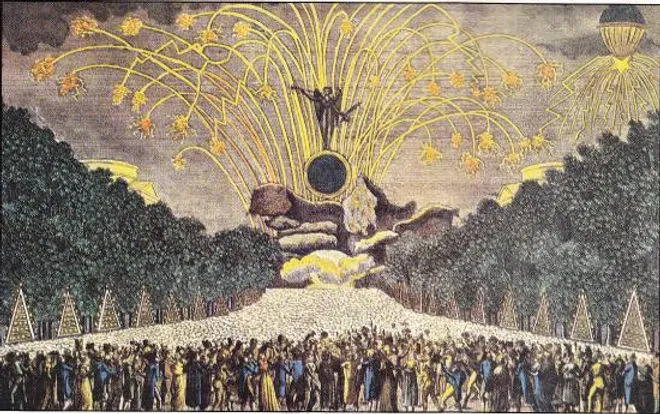
Before it becomes a meticulously timed spectacle, synchronized to music and judged by the emotion it awakens, fireworks were first a riddle for chemists, alchemists, and craftsmen. Its history spans trade routes, royal courts, public squares, and major popular events. It tells of both the gradual mastery of gunpowder and the very human desire to turn the sky into a stage. Even today, when a grand finale sets the night alight, it extends centuries of experimentation, craftsmanship, and boldness.
Origins: black powder and the imagination of ancient China
The history of pyrotechnics generally begins with black powder, a mixture of saltpeter, charcoal, and sulfur. Ancient formulas vary, and accounts sometimes conflict, but one point is universally accepted: it is in China that the earliest uses of these incendiary mixtures took shape. Even before fireworks in the modern sense, people sought to produce noise, smoke, and light, sometimes to ward off spirits, sometimes to signal, impress, or celebrate.
For a long time, legend credited Marco Polo with introducing black powder to Europe upon his return from Asia. Historians now take a more nuanced view, as exchanges between East and West were numerous: trade routes, Arab knowledge, military circulation, and technical translations all played their part. Yet the image remains powerful: a secret from the Far East, capable of transforming war, celebration, and the art of spectacle alike.
From the battlefield to public celebration
In medieval Europe, powder was first associated with war. Those skilled in preparing, storing, and using it were closely tied to artillerymen. This military expertise would gradually extend to civic and princely celebrations. Victories, weddings, royal entries, dynastic births: any display of power could become an occasion for an orchestrated blaze. Fire was no longer only a destructive force; it became a sign of prestige, a demonstration of power and magnificence.
In France, one of the most frequently cited milestones is the great display staged in Paris, Place Royale, now Place des Vosges, to celebrate the union of Louis XIII and Anne of Austria in 1615. This kind of spectacle did not yet resemble modern fireworks. It was as much about ephemeral architecture as about explosions: built scenery, mottos, emblems, chariots, arches, mythological figures, and illuminations formed a true scenography. The pyrotechnician worked with carpenters, painters, architects, and stage machinists. Fire was one element within a larger whole, serving a narrative.
Royal festivities: when pyrotechnics become staging
In the 17th and 18th centuries, European courts refined the art of celebration. At Versailles, in the gardens, perspective, water, music, light, and fire all participated in the same dramaturgy. Fireworks there conversed with fountains, facades, statues, and groves. It was not enough for them to burst: they had to appear in the right place, at the right moment, following a progression legible to spectators.
At that time, fireworks were still predominantly gold, white, and orange, with sparks, sprays, and wheels. Color, as we know it today, remained limited. Beauty came from the overall composition, symmetry, illuminated architecture, surprise, and abundance. One imagines the sky as a canvas, but a canvas still dominated by the gold of powder and the shimmer of incandescent matter.
The 19th century: chemistry opens the color palette
The great aesthetic turning point came with advances in chemistry. In the 19th century, pyrotechnicians better understood the role of metallic salts in coloring flames. Strontium made red possible, barium green, copper delicate blues, and sodium strong yellows. Later, aluminum and magnesium would bring white flashes of new intensity. Pyrotechnics no longer merely produced noise and light: it painted.
This revolution profoundly transformed the language of fireworks. Displays became more nuanced, contrasts richer, finales more spectacular. Mastery of compositions also made it possible to diversify effects: candles, comets, shells, waterfalls, suns, palm trees, weeping willows, crackling, and sparkling trails. Behind every visible figure lies an invisible architecture: the choice of powders, caliber, delay, bursting charge, casing, orientation, altitude, and rhythm.
The 20th century: safety, precision, and the birth of the modern spectacle
In the 20th century, pyrotechnics changed scale. Large public gatherings, national holidays, world expositions, sporting ceremonies, and concerts multiplied the occasions for fireworks. At the same time, the profession became structured around increasingly demanding safety rules. Storage, transport, firing distances, technical approvals, and team training became essential. The audience’s emotion rests on rigorous preparation that is never seen.
Electrical ignition, followed by computerized systems, made unprecedented precision possible. Pyrotechnicians can now compose sequences to the tenth of a second, synchronize launches with a soundtrack, distribute effects across multiple firing points, and create volumes in space. Fireworks became a score. It is no longer simply a succession of pieces: it is a narrative, with an introduction, breathing space, rising tension, ruptures, silences, and finale.
Today: an international art, between tradition and innovation
Contemporary pyrotechnics are an art of synthesis. They bring together chemistry, logistics, music, scenography, computing, visual culture, and a sense of audience. The best pyrotechnic houses have a recognizable signature: some favor density and power, others chromatic finesse, aerial design, humor, musical elegance, or very large-scale effects. In international competitions, this diversity becomes visible: with the same theme, each team reveals a distinct way of thinking about time, space, and emotion.
Masters de Feu, in Compiegne, belong precisely to this lineage. This international pyrotechnic competition showcases the virtuosity of pyrotechnicians and their ability to interpret a theme and turn constraint into spectacle. Modern criteria are not limited to the quantity of effects: synchronization, overall aesthetics, variety, musical coherence, and emotional impact all matter just as much. This is where history meets the present: the pyrotechnician remains a craftsman of fire, but also a director of the sky.
A living heritage, written in the night
From exploding bamboo to aerial shells, from court festivities to major popular gatherings, pyrotechnics have retained a rare power: they bring people together instantly. They speak to everyone, without translation, through light, rhythm, and surprise. Their beauty also lies in their fleeting nature. A fireworks display is prepared for weeks, sometimes months, then disappears in a matter of minutes, leaving only a shared memory.
That is surely what explains its enduring fascination. Each generation inherits ancient knowledge and adapts it to its tools, its safety requirements, and its artistic sensibility. Fireworks are not merely a festive tradition: they are a living, technical, and poetic heritage, with each display writing a new page in the sky.