The night of stars at Masters de Feu: Compiègne’s sky in grand format
On 24 September 2016, the first edition of Masters de Feu invited Compiègne to look skyward for a unique international fireworks competition. Italy, Spain and Austria came together at the Hippodrome for an evening imagined as a shower of stars, blending technical virtuosity, musical emotion and the suspense of the Silver Master.
There are evenings that change the way a place is seen. On 24 September 2016, the Hippodrome de Compiègne was set to become far more than a green setting: an open-air stage, devoted to the greatest gestures of pyrotechnic art. For their first edition, Masters de Feu promised a true night of stars—not the kind seen in silence among the constellations, but those created by human hands, drawn with millimetric precision, synchronized to music and launched into the sky with the finesse of a grand live spectacle.
On 24 September 2016, Compiègne discovers its major pyrotechnic competition
From the outset, the ambition was clear: to establish in Compiègne an international event capable of bringing together the public, fireworks professionals and a jury around one shared standard: beautiful fireworks. Masters de Feu was born as a pyrotechnic art competition, with a principle that was simple in theory and formidable in execution: invite three internationally renowned companies to present a full show each, then judge their creations to award the Silver Master.
This first evening had all the force of a manifesto. It did more than line up luminous tableaux; it affirmed that fireworks can be a composed work, conceived and written in time. A competition pyrotechnic show is not based solely on the power of the finale. It demands dramaturgy, a sense of rhythm, a palette of colours, musical listening and the ability to surprise without breaking the overall balance. It was this artistic dimension that Masters de Feu set out to place at the forefront from the very beginning.
Italy, Spain, Austria: three European schools face the sky
For this first face-off, three countries were represented: Italy, Spain and Austria. The line-up already reflected the spirit of Masters de Feu: bringing together different pyrotechnic traditions, distinct aesthetic sensibilities and teams accustomed both to major public events and international competitions. The Compiègne audience was therefore not attending a single fireworks show, but three signatures, three visions and three ways of sculpting the night.
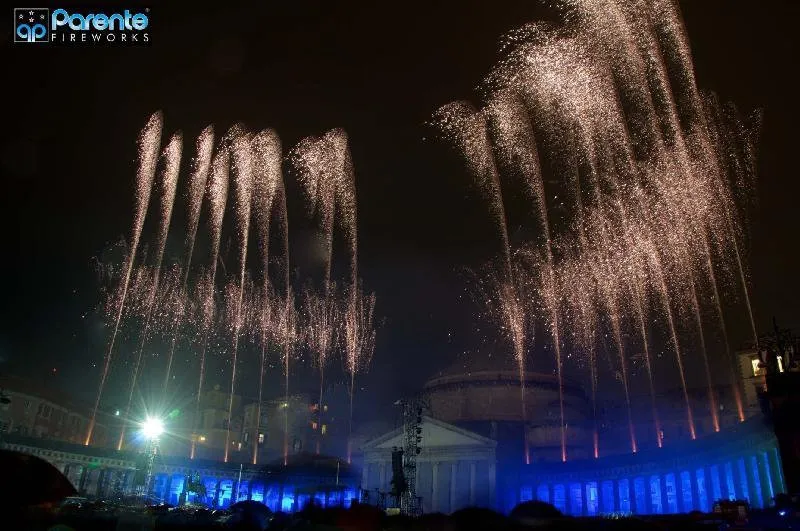
Italy was represented by Parente Fireworks, a house with a long pyrotechnic heritage. Spain entered the competition with Pirotecnia Caballer, a name associated with Valencian pyrotechnic culture and a particularly vibrant firework tradition. Austria was represented by Fire Event, completing this European trio. Three teams, three temperaments, but one shared constraint: to convince in a competition format, under the gaze of a jury and an audience called to experience the evening not only as attentive spectators, but also as witnesses to a founding event.
A rain of stars, but also an exercise in precision writing
The event’s original title, “La nuit des étoiles”, captured the atmosphere to be expected: twinkling lights, bursts, sparkling sprays, suspended crackles, skies opening and closing like theatre curtains. Yet behind the immediate poetry of fireworks lies work of great rigour. Every shell, every comet, every candle, every crackling effect or luminous willow responds to an intention. In a competition, nothing should seem left to chance.
Comfortably seated, spectators could discover the richness of this art, so often reduced to its final moment. A strong pyrotechnic show builds momentum, creates pauses, plays with heights, alternates low blankets of light with grand bursts, and sometimes contrasts the delicacy of a motif with the density of a tableau. There are stars that crack, others that fall slowly, others that multiply into tight bouquets, and others that draw an almost liquid sky. The spectacle lies in this balance between immediate emotion and invisible architecture.
The Silver Master, the first trophy in a story being written
The coveted title in 2016 was the Silver Master. For the competitors, it was not only about winning an inaugural edition: it was also about inscribing their name on the very first line of the honours list. This gave the evening a particular tension. Masters de Feu did not yet have the depth of multiple editions, but it already held a powerful promise: to become an event capable of distinguishing, year after year, exceptional fireworks professionals.
The stakes therefore went beyond ranking. For the public, this first edition was a discovery; for the organisers, an act of birth; for the pyrotechnic houses, a stage to conquer. The competition called for a close reading of the shows: quality of musical synchronisation, originality of the tableaux, technical mastery, emotional intensity, coherence of the programme and ability to leave a mark on collective memory. In a competition firework display, beauty is not always enough; it must be sustained, embraced and carried through to the final silence.
A first edition under the sign of nature
The first edition of Masters de Feu was built around the theme “Dessine-moi la nature”. This choice opened up a particularly fertile field of expression for fireworks professionals. Nature is a vocabulary pyrotechnics knows how to translate with brilliance: flowers of light, rain of gold, blazing palms, silver cascades, spinning suns, coloured waves, clouds of sparks. The sky then becomes a black page on which imagined landscapes and primal sensations unfold in sequence.
The theme also invited a certain delicacy. The aim was not only to create spectacular effects, but to suggest shapes, textures and movements. Nature can be explosive like a storm, slow like a shower of golden stars, vibrant like a field of fireflies, majestic like a dawn. For a first edition, this theme allowed the full scope of contemporary pyrotechnics to be shown: power, finesse, musicality and a sense of storytelling.
Parente Fireworks opens the Masters de Feu honours list
The verdict of 2016 is now part of the event’s history. Parente Fireworks, representing Italy, won the first Silver Master as well as the Audience Prize. Fire Event, for Austria, placed second, ahead of Pirotecnia Caballer, for Spain, in third. This double recognition, from both jury and public, gave the Italian victory a special resonance: it honoured both technical mastery and the audience’s immediate enthusiasm.
This first honours list laid the foundations for an adventure set to grow. It showed that Compiègne could host a major international fireworks competition, that the Hippodrome offered a spectacular stage, and that the public would turn out for an evening devoted to pyrotechnic creation. More than a launch, the 2016 edition was a signal: Masters de Feu had just lit its first star.